Anal Thrombus
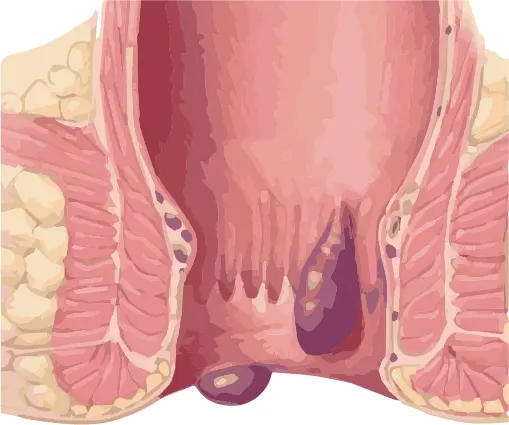
An anal thrombus is a small vein that breaks just outside the anus and clots. It arrives suddenly, sometimes overnight, as a very painful dark purple lump anywhere from the size of a pea to a walnut, often after heavy lifting, coughing or straining.
You may notice
- Sudden, acute pain
- A hard, dark purple lump at the anal opening
- Came on overnight or after straining

What Dr. Cranford does
It is not a true hemorrhoid, and it points to an underlying cause inside the rectum. Even if it ruptures or shrinks on its own, complications are just as likely, so it should not be left to cure itself.
Sudden pain and a lump: call the same-day line.
503.702.4200Common questions
Is an anal thrombus a hemorrhoid?
Not a true one. It is a small vein that breaks just outside the anus and clots, forming suddenly instead of gradually.
Will it go away on its own?
It may rupture or shrink, but complications are just as likely, and it signals an underlying cause in the rectum. It should not be left to cure itself.
What brings one on?
Often heavy lifting, coughing or sneezing spasms, or straining at stool; sometimes nothing obvious.
Anal thrombus: the full entryDr. Cranford’s complete clinical notes, in his own words. 290 words, about 1 min.Read the notes
Sudden paintful hard mass/lession around the anus
Anal thrombus or “thrombotic hemorrhoid” is a common ailment that comes on suddenly. It arrives with acute pain and the appearance of a dark purplish lump just outside the anal opening. The lump may form immediately or appear overnight and varies in size from that of a pea to that of a walnut.
The formation of thrombus generally follows heavy lifting, spasms of coughing or sneezing, straining at stool, etc. It may also occur without any apparent provocation. It is caused by the breaking of a small vein with the escape of blood beneath the skin. The blood becomes clotted shortly after the lump forms. The extreme pain is due to pressure upon the superficial nerve endings. When or if it ruptures, there is almost immediate relief but with the relief comes the peril of having complications if the cause is not remedied. In cases of smaller thrombus, sometimes the bloodstream absorbs the clot so there is no rupture but the complications are just as probable.
Anal thrombus is often confused with actual hemmorhoids, but it is not a true or usual type hemorrhoid. The lump forms suddenly instead of gradually and is formed in the skin on the outside instead of protruding down from the inside, as in hemorrhoids. It is filled with a clot instead of small diseased functioning veins as in hemorrhoids. The recovery from the acute attack is rapid in thrombus, whereas in hemorrhoids the recovery — if any — is gradual. The formation of thrombus is a signal pointing to an underlying cause that will usually be found in the rectum. It is unwise to leave such a condition untreated with the hope that it will cure itself.