Anal Fistula
An anal fistula is a small tunnel that forms after an anal abscess, with an opening inside the anal canal and another on the skin nearby. When it clogs, the pain and pressure build again until it reopens.
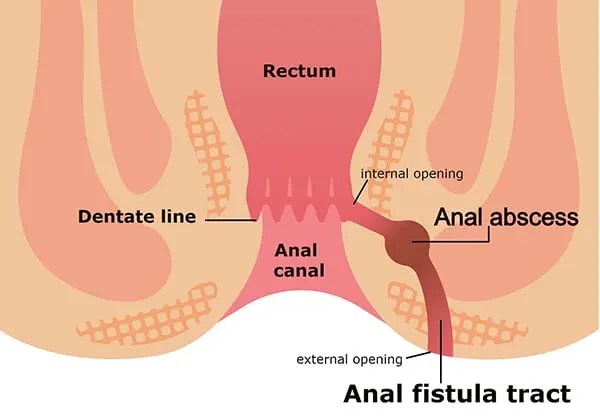
You may notice
- A small opening near the anus that drains pus
- Pain, swelling and redness that come and go
- A history of an abscess
What Dr. Cranford does
A deep infection has to be opened, cleaned out fully and prepared for healing; neglected fistulas undermine the surrounding tissue and need larger surgery later. Dr. Cranford’s methods are conservative, with no hospitalization.
Common questions
Where does an anal fistula come from?
Fistulas almost always develop from an anal abscess, although not every abscess becomes a fistula.
If it stops hurting, is it healed?
Not necessarily. A fistula can drain and feel better, then clog and flare up again. The infection has to be opened, cleaned out and prepared for healing.
Will I need to go to the hospital?
Dr. Cranford’s methods for fistula are conservative and involve no hospitalization.
Anal fistula: the full entryDr. Cranford’s complete clinical notes, in his own words. 328 words, about 1 min.Read the notes
A fistula is a tube filled with pus. Anal or rectal fistulas (or fistulae) have one or more openings in the buttocks near the anal opening, and another one (the feeder) is inside the anal canal or rectum. Fistulas almost always develop from abscesses, although not all abscesses become fistulas. As an abscess forms, all of the typical symptoms of pain, swelling, heat and redness appear. The symptoms worsen until the abscess either points (becomes a fistula) and breaks, or is lanced by a physician. At that point, much of the pain and pressure that has built up is relieved. The patient may think his trouble is over, but more needs to be done to complete the treatment process. For example, the opening (or fistula) which has drained the abscess can become clogged. When this happens, the patient again undergoes the same suffering as before until the fistula tube reopens or a new opening is formed to provide drainage for the accumulated pus and debris. If the fistula drains continuously on its own, the pain and suffering is often negligible. It’s the body’s adaptation to a deep infection. However, even when this happens, the infected area is still dumping pus and toxic material into the bloodstream poisoning and depleting the entire system.
A deep infection in the rectal area, whether or not it has become an abscess or fistula, must be opened, fully cleaned out and prepared for healing. Many chronic ailments are caused by the absorption of toxins or poisons from some chronically infected area. If fistulae are neglected they eventually undermine all of the tissues surrounding the rectum. The surgery required to remove the infection covers a larger and larger area as time goes on.
Anal fistula is a critical ailment that requires skill and experience if further complications are to be avoided. Dr. Cranford’s methods are conservative. There is no hospitalization and he can reasonably assure satisfactory results in every case he accepts for treatment.