Hemorrhoids; A Disease No One Talks About
Everyone has cushions of blood vessels in the lower rectum. They are only called hemorrhoids when they swell, slide down and cause trouble: bleeding, pain, something coming out, itching. It is common and it is treatable, and Dr. Cranford treats it on an outpatient basis without hospital surgery.
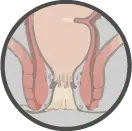
The four signs
- Bleeding
- Bright red. Hemorrhoids cause 75% of all bleeding from the large bowel; how much depends on how severe they are.
- Pain
- Internal hemorrhoids usually do not hurt unless strangulated. Pain points to mixed or external hemorrhoids, at or below the anorectal line.
- Protrusion
- Something comes down, most noticeably during a bowel movement. How far it comes is its degree.
- Itching
- When they stay out, leakage and soiling follow (wet anus syndrome), and with them persistent itching.
How far does it come down?
Proctologists grade internal hemorrhoids by degree. Any degree may or may not bleed. Step through them:
No protrusion, but may bulge into the anal canal.
It may or may not bleed.
Comes down during a bowel movement, then goes back in on its own.
It may or may not bleed.
Comes down during a bowel movement and has to be pushed back in by hand.
It may or may not bleed.
Permanently down and cannot be pushed back in.
It may or may not bleed. Leakage, soiling and itching become more common.
Every treatment option, compared.
Dr. Cranford has used most of these himself. Here is how they work, who they suit, and what he found.
| Treatment | How it works | Best for | Dr. Cranford’s note |
|---|---|---|---|
| Keesey technique | A very low electrical current through a small electrode makes the hemorrhoid shrink and shrivel. | Internal hemorrhoids, and rectal prolapse. | What Dr. Cranford uses: about 80,000 treatments, best tolerated, most effective, fewest side effects in his experience. |
| rubber band ligation | A tight band cuts off blood flow until the tissue dies and falls away. | 1st, 2nd and early 3rd degree internal. | Leaves minimal scar tissue. |
| sclerotherapy | An injection above the hemorrhoid makes it shrink and retract. | 1st and 2nd degree internal. | Effective, but has lost popularity and is hard to find. |
| infrared photocoagulation | Short bursts of infrared light destroy the tissue. | 1st to 3rd degree internal. | He used it extensively; the equipment kept failing. |
| cryotherapy | Liquid nitrogen freezes the hemorrhoid. | No longer clinically popular. | Not exact enough; how much tissue sloughs is unpredictable. |
| hemorrhoidectomy | Surgery cuts the hemorrhoids out and closes the wounds. | Only the most severe 3rd and 4th degree cases. | One of the most painful recoveries there is. Try every non-surgical option first. |
Make sure it is hemorrhoids
Many conditions around the anus look and feel alike, so a proper exam comes first: your history, a look, and an anoscopy, with a proctosigmoidoscopy when the lower bowel needs checking.
Common questions
Do hemorrhoids always need surgery?
No. Surgery (hemorrhoidectomy) is reserved for the most severe cases, and Dr. Cranford rarely sees a case that needs it. Most hemorrhoids are treated in the office with the non-surgical Keesey technique.
Why do hemorrhoids bleed?
Hemorrhoids are swollen cushions of blood vessels. Bleeding from them is bright red, and hemorrhoids cause about 75% of all bleeding from the large bowel. Bleeding can also come from other conditions, so it should be examined.
Are hemorrhoids painful?
Internal hemorrhoids are usually not painful unless they are strangulated. Pain usually means the problem is at or below the anorectal line: mixed or external hemorrhoids, or something else such as an anal fissure.
What do the degrees of hemorrhoids mean?
They describe how far an internal hemorrhoid comes down: 1st degree does not protrude, 2nd goes back in on its own, 3rd has to be pushed back in, and 4th stays out. See degree (of hemorrhoids).
Hemorrhoids: the full entryDr. Cranford’s complete clinical notes, in his own words. 1,687 words, about 8 min.Read the notes
Learn More About Hemorrhoids
What are hemorrhoids?
Hemorrhoids can be defined in a couple of different ways. The “not so clinical definition” is they are merely varicose veins located in the anorectum. A more recent study has described the presence in the anal canal/lower rectum of specialized highly vascular “cushions” or “pads” consisting of discrete masses of thick submucosa which contain blood vessels, smooth muscle and elastic and connective tissue. It is suggested that hemorrhoids are nothing more than sliding downward of this part of the anal canal lining. Such cushions are present in everyone, and it is suggested that the term “hemorrhoids” be confined to situations where these cushions are abnormal (enlarged, inflamed) and cause symptoms. The cushions or pads are located in three constant sites; right anterior, right posterior, and left lateral, and upon examination, this is where the examiner will see the presence of hemorrhoidal disease. This is also called the “Surgical Y”.
Types of hemorrhoids
Internal hemorrhoids; symptomatic, exaggerated submucosal vascular tissue located above the anorectal line and are covered by transitional and columnar (mucosal) epithelium.
The following allows the proctologist to establish a baseline for the purpose of discussion of this disease with a nomenclature that is consistent.
1 degree
no protrusion, but may bulge into the anal canal/ may / may not bleed.
2 degree
protrudes at the time of BM, but reduces spontaneously, may/ may not bleed.
3 degree
protrudes at the time of BM, must be manually reduced, may/ may not bleed.
4 degree
permanent prolapse/ protrusion and cannot be reduced, may/ may not bleed.
Mixed hemorrhoids – a combination of both internal and external hemorrhoids. Clinically these are hemorrhoids that usually occur in the confines of the anal canal and are covered by modified stratified squamous epithelium.
Strangulated hemorrhoids – these are a combination of both internal and external hemorrhoids, which are characterized by mucosal and anal prolapsus, intense spasms of the internal and external sphincter muscle group, cutting off the blood supply and usually contains multiple blood clots. Because of the vascular abnormality due to the muscle spasm and if allowed to progress, this type of hemorrhoidal disease can progress to become necrotic and gangrenous.
Signs/Symptoms of hemorrhoidal disease-
Bleeding – 75% of all bleeding from the large bowel is caused by hemorrhoidal disease. Bleeding associated with hemorrhoids will be bright red and the amount will be dependent upon the severity of this condition. Anemia is not uncommon and at times hospitalization is necessary due to blood loss.
Pain – one must recall the anatomy of the anorectum when interpreting pain patterns consistent with hemorrhoids. Internal hemorrhoids are usually not painful unless strangulated. When there is pain involved with hemorrhoids it is indicative that the condition originates at or below the anorectal line therefore being consistent with mixed or external hemorrhoidal disease.
Protrusion/ Prolapse – if the hemorrhoidal disease has progressed then there is frequently protrusion, which is most noticeable during defecation. If the protrusion is constant (4 degree hemorrhoids) then mucosal leakage and fecal soiling is more common (wet anus syndrome). This frequently causes persistent pruritus/ itching as a common symptom.
Diagnosis of hemorrhoids
Care history – usually a patient will have a rich history of this condition, dating back for years prior to consulting a physician. The typical complaints will be the symptoms previously discussed; bleeding, protrusion, slight pain and itching or perianal irritation. Bowel patterns prior treatment OTC medications constitutional diseases such as IBS, ulcerative colitis, Crohn’s disease etc. should all be excluded as possible contributors to this condition and need to be addressed. Dietary history, as it may be related to proper bowel pattern, should be discussed.
Inspection – visual inspection of the external perianal skin is essential is the differential diagnosis of this condition. All types of hemorrhoids (prolapsing internal, mixed, external and strangulated) are readily visible and recognized by the experienced clinician.
Anoscopy -this is the definitive examination to determine the extent of the hemorrhoidal condition. The use of a disposable anoscope (Hinkel-James) is best when performing this procedure, and at times a topical anesthetic may be indicated to reduce discomfort. Mild straining by the patient at times may help assess the amount of prolapse present. Other conditions, such as hypertrophied anal papilla, rectal polyps, anal fissures etc. may also be disclosed.
Proctosigmoidoscopy – this procedure is used to best assess the condition of the rectum and the lower bowel. The flexible sigmoidoscope allows the examiner to readily view the status of the bowel mucosa (Crohns disease, ulcerative colitis, IBS etc.) and exclude or confirm the presence of colorectal cancer.
Treatment of hemorrhoids
When a diagnosis of hemorrhoids is made and the origin of the bleeding has determined the etiology to be that of hemorrhoids, then the following treatment options may be employed.
Rubber band ligation – this is the use of a device called a “Baron’s ligator” where a constricting rubberband is placed around the prolapsing hemorrhoid, restricting its blood flow and constricting the tissue until it becomes necrotic. The “dead” hemorrhoidal tissue sloughs and is replaced by minimal scar tissue. This type of treatment is best for internal hemorrhoids grades 1 degree, 2 degree and early 3 degree
Cryotherapy – this is the destruction of hemorrhoids by freezing with liquid nitrogen (-180 degree C). This technique had a brief window of popularity, but is no longer clinically popular. I had experience with this procedure and found it not practical, as storage of the liquid nitrogen is difficult and instructions in its use says to apply the “probe” to the tissue until it turns white” and then remove. This is not exact enough for the clinician and the amount of tissue that sloughs is somewhat unpredictable.
Sclerotherapy – this is the injection of 5% phenol in vegetable oil submucosally above the hemorrhoid. Usually 3-5cc are placed at each hemorrhoid site. This is a procedure that has its origin in Great Britain. It causes fixation, retraction and partial atrophy of the hemorrhoidal disease. It is indicated in 1and 2-degree internal hemorrhoids and is very effective. Possible side effects are scar tissue formation and rectal stricture, which usually occur if there are excess amounts of the phenol and oil solution is injected. It is contra-indicted in patients with ulcerative colitis, leukemia, lymphoma or portal hypertension. For some reason, this technique has lost clinical popularity, and is not readily available.
Infared Photocoagulation (IRPC) – this is the application of a laser like devise that emits infared light that causes destruction of the diseased tissue. It is applied in bursts of 0.5 to 3 seconds per site and is effective on 1, 2 and 3 degree internal hemorrhoids. Side effects are similar to other treatments; bleeding, pain and rectal stricture. I had extensive experience with this procedure and the biggest problem was equipment failure. The disposable tips were very expensive and the power generator spent more time at the manufacturer that in my office.
Surgical hemorrhoidectomy – this procedure is reserved for the most severe cases of hemorrhoidal disease. When one has internal hemorrhoids 3 or 4 degree and coexistent prolapsus, closed hemorrhoidectomy may be the only option. In my practice it is unusual to see a clinical situation where hemorrhoidectomy is necessary, but when indicated this may be the patients only viable option. The procedure is just a matter of dissecting the diseased tissue from the anal verge up to the anorectal ring and then closing the wound. There are usually 3 incision sites located in the right posterior, right anterior and left lateral quadrants. Bleeding is controlled by electrotherapy and running sutures. Needless to say, this procedure is post-surgically one of the most painful experiences an individual will even endure. Complications are bleeding, intense post-operative pain and scar tissue formation, which may lead to proctostenosis, or a narrowing of the ano-rectal canal. Sometimes the opposite occurs where division or inadvertent muscle/ neurological damage may lead to incontinence or wet anus syndrome. When possible, it is clearly obvious that one should resort to all non-surgical options prior to submitting to surgical hemorrhoidectomy.
Negative galvanic treatment/ “Keesey” treatment – this type of non-surgical treatment is the application of a negative galvanic current by way of a disposable metallic electrode to the diseased hemorrhoidal tissue. It was first discovered by WE Keesey who published an article in 1934 on its clinical application. The negative galvanism causes NaOH (sodium hydroxide) to form at the contact point of the negative electrode, thus causing thrombogenesis and destruction of the hemorrhoidal vascular bed, leading to reduction and removal of internal hemorrhoids. The amount of current is usually somewhere between 15 to 18 Ma for approximately 5-7 minutes per treatment site. The number of treatments is determined by the severity of the hemorrhoidal disease. Treatment may easily be administered on consecutive days with as many as 3 to 4 treatments in a 24-hour period. The typical case with internal hemorrhoids 2-3 degrees may require 8-12 treatments. Side effects include pain and bleeding, but remember that the mucosa is void of somatic sensory enervation allowing this treatment to be administered with little or no discomfort. I have used a variety of the aformationed non-surgical treatments (ligation, IRPC etc.) and the negative galvanic (Keesey) technique is the best tolerated, most effective and has the least likelihood of initiating unwanted side effects (pain, bleeding, infection etc.). In my 37 years of practice at the Sandy Blvd. Rectal Clinic-Portland I have administered approximately 80,000 (Keesey) treatments with few complications and very good outcome. This treatment offers to patient a great alternative to conventional surgical procedures with a predictable outcome that is quite satisfactory.
I hope this brief outline has enlightened the reader to his/her options when addressing annoying hemorrhoidal condition. Please be mindful that there are a myriad of diseases that occur in/ around the anorectum and colon, and proper examination is necessary to make a positive diagnosis. The presence of conditions such as anal fissures, fistula disease, rectal prolapse, pruritus ani (itching), perianal abscess, skin tags, venereal disease (condyloma, herpes, gonorrhea), perianal skin cancer, and colorectal cancer, emphasize the importance of proper diagnosis.